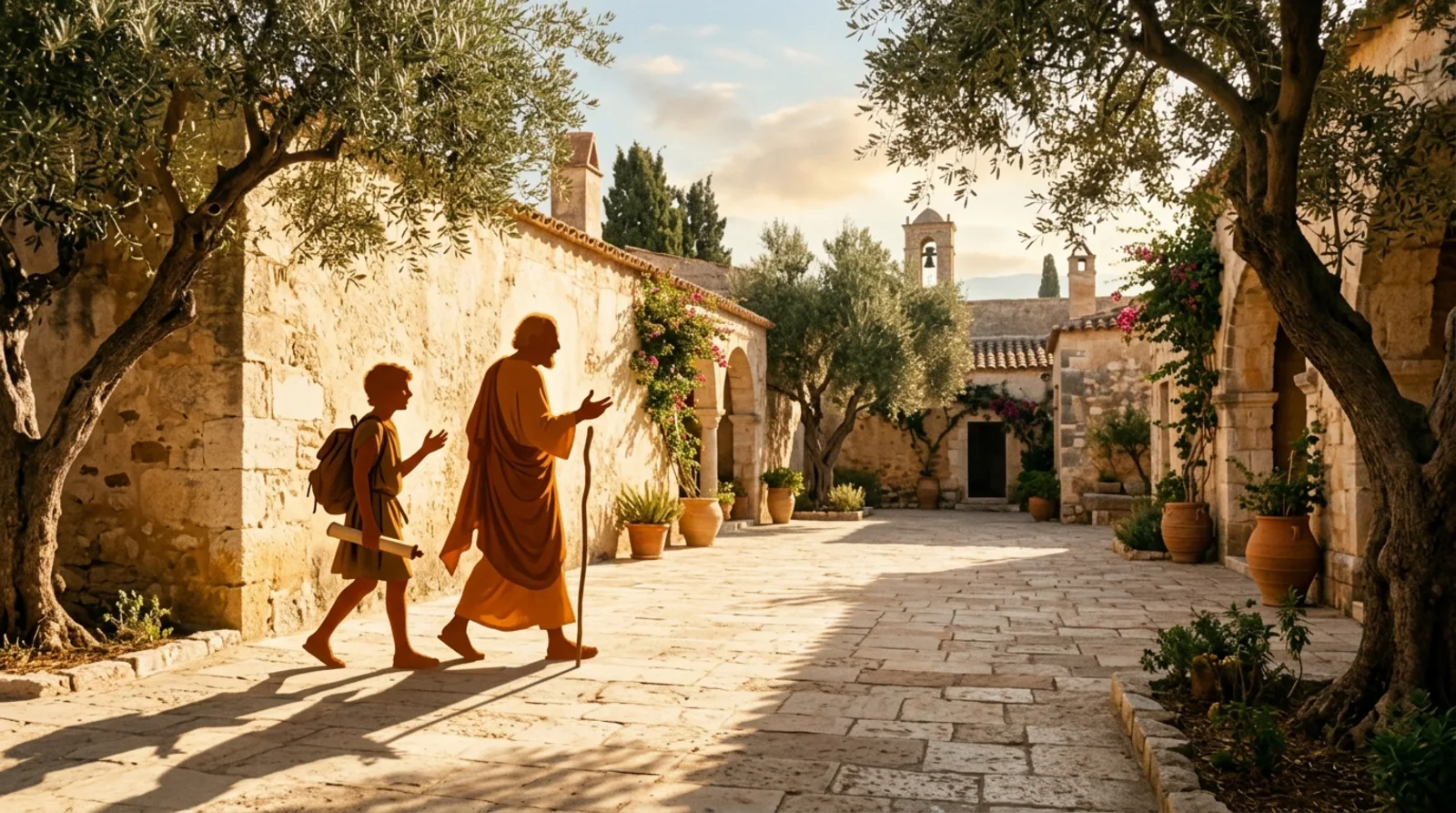
One method. Twenty-four centuries. Still undefeated.
The Socratic method is a structured way of testing an idea by questioning it until it either breaks or proves itself — and it has outlived every study technique invented since. It comes from the Athenian marketplace, survives in Plato's dialogues, and runs today in law schools, seminar rooms, and one place it never ran before.
Where it comes from
Socrates taught in fifth-century Athens without a school, a book, or a fee. His classroom was the agora; his method, recorded in Plato's dialogues, was the elenchus — the cross-examination. He asked an expert to define the thing they were expert in. Then he tested the definition until its owner discovered they had never actually examined it. The point was never humiliation. The point was that an idea you cannot defend is an idea you do not yet hold.
The five moves
- Wonder. A real question, honestly held. Not "what is the answer" but "what is actually true here?"
- Hypothesis. A first answer, stated plainly enough to be tested. Vague answers are unfalsifiable and therefore unteachable.
- Elenchus. The cross-examination. Counterexamples, edge cases, consequences — the answer is pushed until it bends. This is the move everyone remembers.
- Revision. The answer is rebuilt to survive what broke it. Most learning lives in this step.
- Aporia. Sometimes the answer does not survive, and what remains is honest puzzlement. Socrates counted this as progress — the student who knows their answer fails is ahead of the one who never tested it.
Questions that do the work
Three families carry the whole method.
Definition: What exactly do you mean by that? Is there a case where the definition fails? Would you still call it that if the circumstances reversed? Evidence: How do you know? What would change your mind? What is the strongest argument against your position — stated fairly? Consequence: If that were true, what would follow? Does it follow in every case? Are you willing to accept everything it implies?
Twelve questions, endlessly recombined — that is the entire engine of Western critical thinking.
For teachers: the seminar, upgraded
Socratic seminars usually launch in September, and the hardest part is always the same: students have never seen the method done well before being asked to do it. There is now a fix for that. At LegendLabs, students practice against Socrates himself — a hyperreal AI recreation, rooted in Plato's dialogues and labeled as a recreation, who runs the elenchus on their actual ideas. Ten questions free per student. A class that has been cross-examined by the original arrives at its first seminar knowing exactly what the job is.
For students: the method as a study tool
Rereading feels like learning and mostly is not. The Socratic move — explain the idea in your own words, then attack your own explanation — is self-testing, the technique memory research keeps crowning. The difficulty is doing it alone. It is easier when the man who invented the attack does it for you: he hears your explanation, then finds the one assumption you did not know you were making.
Questions people search
What are the five steps of the Socratic method? Wonder, hypothesis, elenchus, revision, aporia — detailed above. Most modern versions rename them; none improve them.
Is the Socratic method just asking "why" repeatedly? No. Repeated "why" is a drill; the elenchus is a structured test of definitions, evidence, and consequences. The difference is the difference between annoying a student and teaching one.
What is the difference between a Socratic seminar and the Socratic method? The method is the questioning structure. The seminar is a classroom format where students apply it to a shared text — the method, distributed across a room.
Twenty-four centuries of teachers have borrowed the method. The original is back on the job.
More from LegendLabs: Talk to Socrates AI · Interview a Historical Figure: The Project Guide · Talk to Historical Figures AI — Meet the Faculty